

DLS Method Explained: How Cricket Sets Fair Targets in Rain-Hit Matches
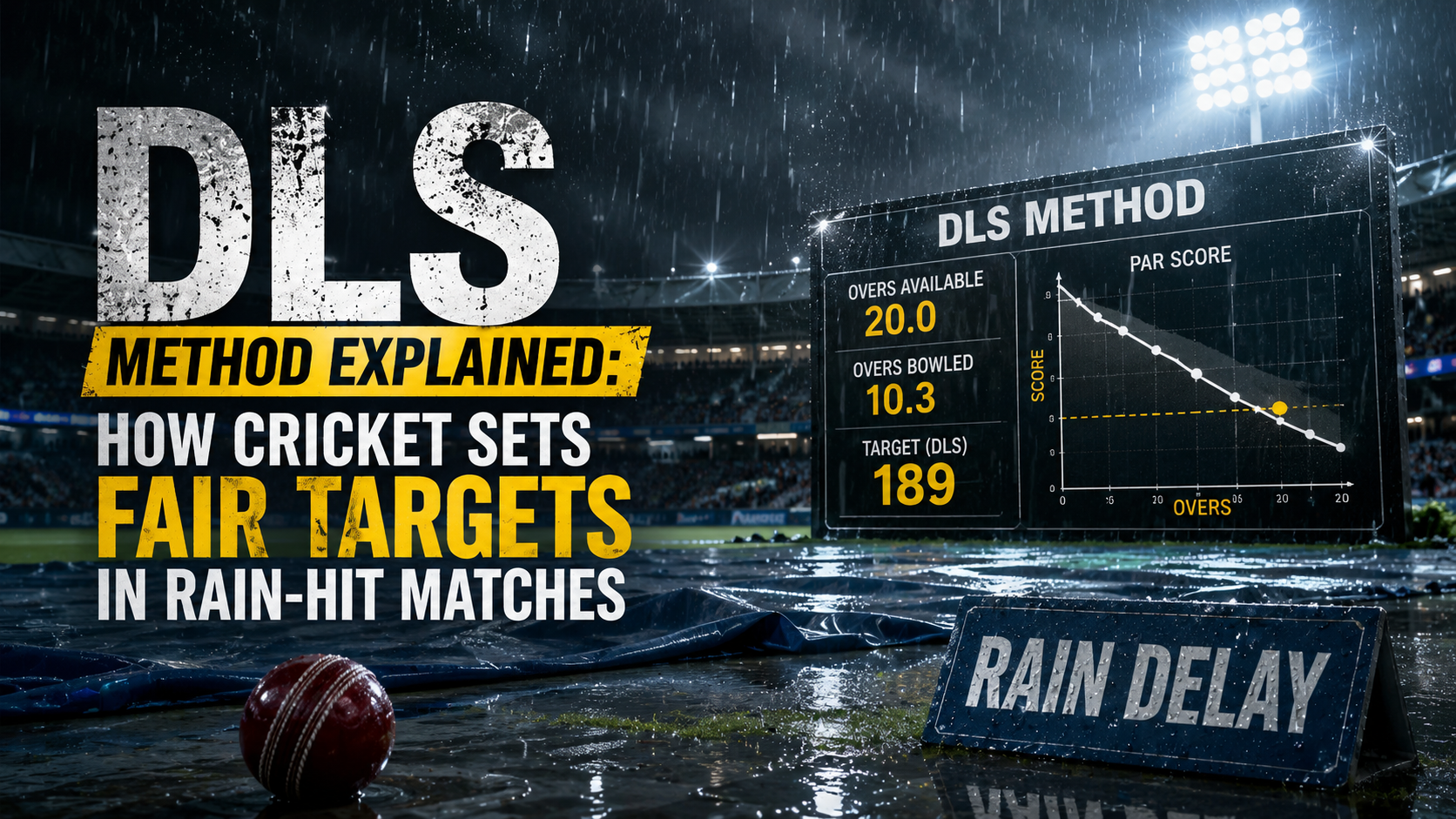
Picture the scene. Your team is cruising in a run-chase, the required rate is under control, and then the heavens open. Twenty minutes later the covers come off, the overs have been slashed, and a new target flashes on the big screen that seems to make no sense at all. Groans ripple around the stadium. How on earth did they arrive at that number?
The answer is the DLS method, cricket’s mathematical referee for rain. It is one of the most misunderstood parts of the sport, yet the logic behind it is surprisingly elegant. This is the DLS method explained in plain language.
Why Cricket Needed a Rain Rule in the First Place
Before we get to how DLS works, it helps to understand the chaos it replaced.
Rain has always been cricket’s uninvited guest, and for decades the sport had no fair way to handle it. The Average Run Rate method simply compared run rates, which heavily favoured the team bowling second, while the Most Productive Overs method produced results so absurd they became infamous.
The breaking point came at the 1992 World Cup semi-final, when South Africa needed 22 runs from 13 balls against England and a brief shower left them chasing an impossible 21 runs from a single delivery. A promising chase was ruined not by cricket, but by bad maths.
The Origins: From Duckworth-Lewis to DLS
That something better arrived thanks to two English statisticians.
Frank Duckworth and Tony Lewis devised a system that treated the problem mathematically rather than crudely. Their method was first used in international cricket in 1997 and officially adopted by the International Cricket Council in 1999.
In 2015, Australian academic Professor Steven Stern took over as custodian and refined the formula to reflect modern scoring patterns, particularly the aggressive batting of the T20 era. The system was renamed the Duckworth-Lewis-Stern, or DLS, method, and that is the version cricket uses today across all limited-overs internationals.
The Core Idea: It’s All About Resources
Here is the single concept that makes everything click. Forget run rate for a moment and think in terms of resources.
The DLS method is built on one elegant principle: a batting team begins its innings with two resources, the overs available and the wickets in hand. In an ODI, that is 300 balls and ten wickets. As the innings unfolds, both resources deplete, hitting zero only when a team either uses up all its deliveries or loses all ten wickets.
Overs and Wickets Are Not Equal
The clever part is that DLS does not treat these resources as a straight line. Losing overs early, with all wickets intact, costs far more scoring potential than losing overs late. A team that has lost eight wickets, meanwhile, has very little resource left even with overs available, because it cannot afford to attack.
DLS captures all of this in a pre-calculated resource table. Every combination of overs remaining and wickets lost corresponds to a percentage of total resources: a team starting fresh has 100 percent, one deep into its innings with few wickets left only a fraction.
Turning Resources Into a Target
Once you think in percentages, the target becomes intuitive. In simple terms, the second team’s par score equals the first team’s score multiplied by the ratio of the two teams’ resource percentages. If the chasing side has access to fewer resources than the team that batted first, its target is scaled down. If a quirk of the interruption leaves it with more, the target can actually be scaled up.
DLS in Action: A Simple Example
Imagine Team A bats its full 50 overs and posts 250, using 100 percent of its resources. Rain then reduces Team B’s chase to 25 overs. Team B has not lost the same proportion of resources as a straight halving of overs suggests, because it still has all ten wickets in hand and can attack from the outset.
The resource table might tell us Team B has around 66 percent of resources available rather than 50 percent, so its target is calculated from that figure, not by simply halving 250. This is exactly why revised targets so often surprise fans: the maths accounts for wickets in hand, not just the reduced overs. The chasing side still has to go out and get the number, of course, and under lights on a shortened night that pressure only grows. Because DLS decides the very figure a team must reach, it sits at the heart of some of the tensest finishes in the sport, including several among the highest successful run-chases in ODI and T20 history, where revised and par-score situations turned tight games on their head.
The Strengths and the Criticisms
No system is perfect, and DLS attracts its share of debate.
Where DLS Gets It Right
Its great strength is fairness and consistency. By accounting for both overs and wickets, it produces far more balanced outcomes than any predecessor, and it can generate an up-to-date par score at any moment during a chase. This predictability and mathematical fairness is crucial not just for teams and fans, but also for anyone analyzing live match dynamics or placing in-play trades on a sport betting exchange, where live odds rely heavily on accurate, real-time par scores.
The criticisms are real, though. It cannot measure the quality of the batters at the crease, treating a set superstar and a nervous number nine identically. Its resource values come from a computer programme and are not fully public, and in the ultra-aggressive T20 format some argue it still struggles to keep pace with modern scoring. Even so, it remains the most reliable rain rule cricket has ever had.
Conclusion
The DLS method may look like a black box that spits out baffling numbers, but at its heart lies a genuinely fair idea: measure what each team had to work with, and set the target accordingly. By treating overs and wickets as depleting resources rather than relying on crude run rates, it rescued cricket from the farce of impossible rain-hit equations. It is not flawless, but the next time a revised target flashes up mid-storm, you will know it is not random at all. It is decades of careful mathematics doing its quiet best to keep the game fair.
Frequently Asked Questions (FAQs)
- What does DLS stand for in cricket? DLS stands for Duckworth-Lewis-Stern, named after statisticians Frank Duckworth, Tony Lewis and Steven Stern, who developed and refined the method for setting fair targets in rain-affected limited-overs matches.
- How does the DLS method calculate a revised target? It treats overs and wickets as resources and sets the chasing team’s target in proportion to the resource percentages each side had available, rather than adjusting for lost overs alone.
- Why do DLS targets sometimes seem higher than expected? Because the method accounts for wickets in hand. A team with fewer overs but all its wickets retains a large share of scoring resources, so its target is not simply reduced in line with the lost overs.
- When was the DLS method first used? The original Duckworth-Lewis method was first used internationally in 1997 and adopted by the ICC in 1999. It was renamed DLS in 2015 after Steven Stern’s revisions.
- Is the DLS method used in Test cricket? No. DLS applies only to limited-overs formats such as ODIs and T20s, because Test cricket is not restricted by a fixed number of overs.
- What are the main criticisms of the DLS method? It cannot factor in the quality of batters at the crease, its resource values are not fully public, and some feel it does not fully capture the scoring rates of modern T20 cricket.
-

U19 World Cup 2024 Final: India outclassed by Australia
• 12 Feb, 24 • by Flash ExchangeIndia's battle to grab the title at the U19 World Cup 2024 ended in a heart-wrenching loss to Australia in the final. Despite their best efforts, India fell short, finishing as runners-up for the fourth time overall and the third time in the last five editions.
-

Most Catches by a Fielder in IPL History
• 22 Mar, 24 • by Flash ExchangeIn cricket, just like any other sport, fielders can make a huge difference in whether their team wins or loses. A dropped catch at a crucial moment can cost the team the game, while an amazing catch, especially a difficult one, can give the team a big boost and turn the tide in their favor. Here are the top 5 players with the most catches in the history of the Indian Premier League (IPL):
-

Portugal Celebrates Cristiano Ronaldo’s Legendary Legacy with Stunning CR7 Euros Coin
• 16 Sep, 24 • by Flash ExchangeCristiano Ronaldo is more than just a footballer; he is a global icon whose name is synonymous with greatness. As one of the most decorated athletes