

Cricket Betting Terms Every Beginner Should Know
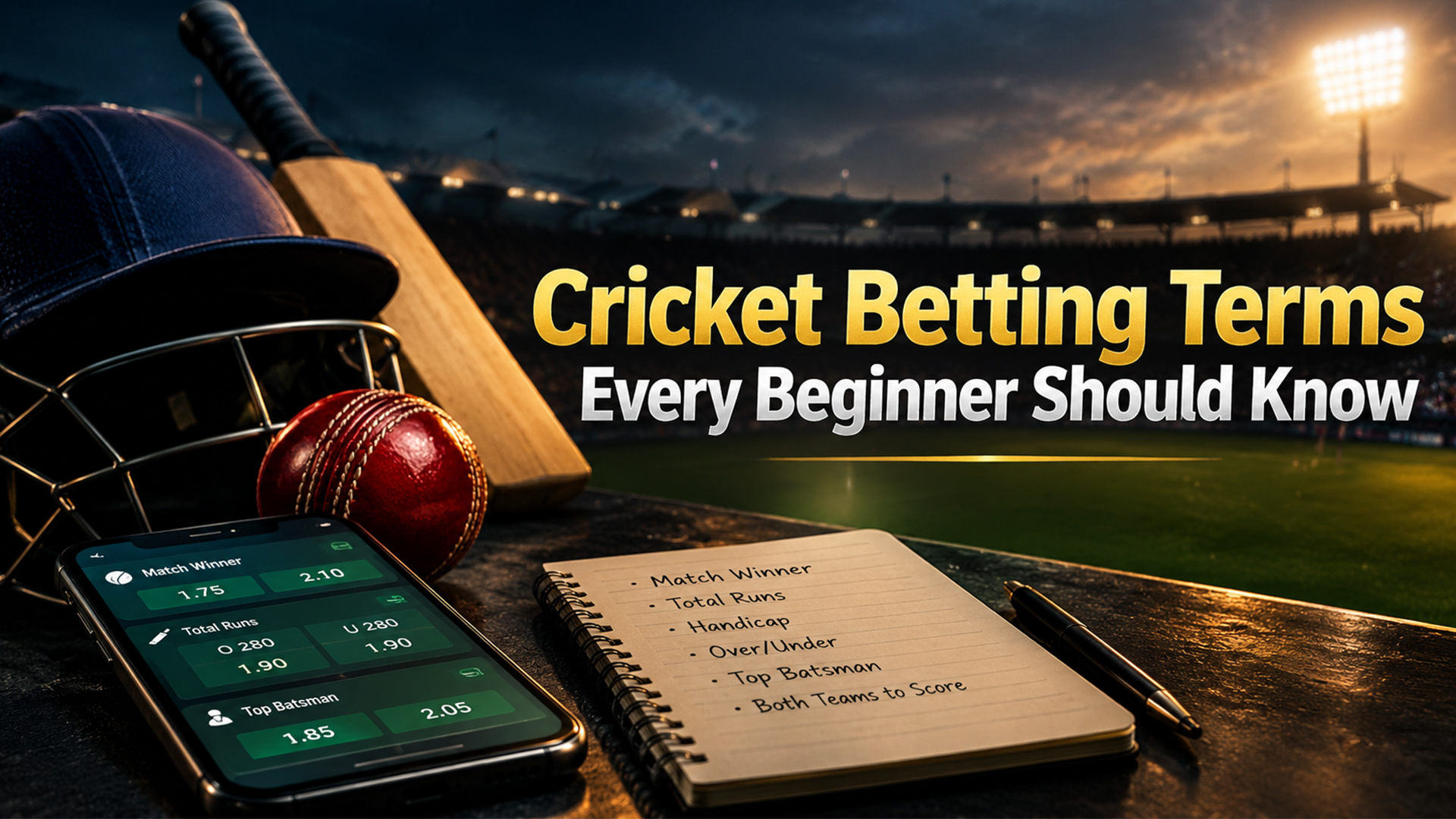
Cricket has its own language, and betting markets add another layer of terminology. Beginners may encounter terms such as odds, stake, back, lay, liability, market, over/under, in-play, cash out, and liquidity without immediately understanding what they mean.
Knowing these terms is important because a betting screen can contain several conditions in only a few words. Understanding the terminology helps you read those conditions more carefully and avoid misunderstandings.
This guide explains the most common cricket betting terms in plain English. It is intended as an educational reference, not as a promise of profit or a recommendation to bet. Real-money betting involves financial risk, and applicable laws and platform rules should always be checked before participating.
Cricket Betting Terms at a Glance
| Term | Simple meaning |
|---|---|
| Bet | A prediction or wager on a particular outcome |
| Stake | Amount of money placed on a bet |
| Odds | Price associated with a betting outcome |
| Return | Total amount received if a bet settles successfully |
| Profit | Return minus the original stake |
| Market | A particular betting option |
| Back | Betting that an outcome will happen |
| Lay | Betting that an outcome will not happen |
| Liability | Potential loss on a lay position |
| In-play | Betting while a match is taking place |
| Over/Under | Betting whether a statistic finishes above or below a line |
| Liquidity | Money available in an exchange market |
| Commission | Fee charged by some betting exchanges |
| Cash Out | Feature allowing a position to be settled before the event ends |
What Are Cricket Betting Terms?
Cricket betting terms are words used to describe betting actions, odds, markets, match conditions, settlements and account mechanics.
Some terms come directly from cricket, such as innings, powerplay and run rate. Others belong specifically to betting, such as stake, odds, liability and market.
Understanding the difference is useful because a cricket match can contain several markets at the same time.
For example, a platform might display markets related to:
- Match winner
- Total runs
- Top batter
- Top bowler
- Team totals
- Over/under
- Player performance
- Specific innings
- Live or in-play events
The exact markets available can vary by platform, competition and match.
Basic Cricket Betting Terms
Bet
A bet is a wager placed on a particular outcome or condition.
For example, a market may ask which team will win a match. A participant selects an available outcome and places a stake according to the platform’s rules.
Stake
The stake is the amount of money placed on a particular bet.
If someone places ₹100 on a market, ₹100 is the stake. The stake should be treated as money that could be lost rather than money that is guaranteed to return.
Odds
Odds indicate the price associated with a particular outcome.
Decimal odds are commonly displayed as numbers such as 1.50, 2.00 or 3.00. They can be used to calculate a potential return, but odds do not guarantee that an outcome will occur.
For example, with decimal odds of 2.00 and a ₹100 stake, the mathematical total return would be ₹200 if the bet qualifies for that return under the market’s settlement rules. The ₹200 includes the original ₹100 stake.
Return
Return is the total amount received from a successful bet according to its odds and applicable rules.
Return is different from profit because the return can include the original stake.
Profit
Profit generally means the amount left after subtracting the original stake from the total return.
For example:
- Stake: ₹100
- Total return: ₹200
- Profit: ₹100
Actual settlement can differ depending on the market, fees, commission and platform rules.
Market
A market is a specific betting proposition.
“Match Winner” is one market. “Total Match Runs” can be another. A single cricket match may contain many different markets.
Always read the complete market description before placing a bet.
Cricket Betting Odds Explained
Decimal Odds
Decimal odds show a multiplier for the total return.
For example, decimal odds of 2.50 mean:
₹100 × 2.50 = ₹250 total return
That does not mean ₹250 is guaranteed. It is simply the mathematical return if the selection qualifies for the stated odds and settlement conditions.
Implied Probability
Implied probability is a mathematical conversion of odds into a percentage.
A simplified calculation for decimal odds is:
Implied probability = 1 ÷ decimal odds × 100
For odds of 2.00:
1 ÷ 2.00 × 100 = 50%
This is an interpretation of the price, not a guarantee of the actual probability of the event.
Overround or Margin
In bookmaker markets, the implied probabilities of all available outcomes can add up to more than 100%. This difference is commonly referred to as the overround, margin or bookmaker’s margin.
Understanding this concept helps beginners recognize that odds are not simply neutral predictions.
Back
Back means betting that a particular outcome will happen.
For example, backing Team A in a match-winner market means selecting Team A to win according to the market’s settlement conditions.
Lay
Lay means taking a position that an outcome will not happen.
Lay betting is particularly associated with betting exchanges. It is different from ordinary “back” betting and can involve liability that is greater than the initial amount someone receives or focuses on.
Beginners should understand the potential liability before using a lay market.
Common Cricket Betting Markets
Match Winner
A match-winner market asks which team will win the match under the market’s settlement rules.
Possible outcomes can depend on the competition and rules, particularly where matches can end in a tie, no result or abandonment.
Total Runs
A total-runs market relates to the number of runs scored by a team or across a match.
The market description should make clear whether it refers to a particular innings, team or entire match.
Over/Under
Over/Under markets use a numerical line.
For example, a market could specify whether a team’s total will be over or under a particular run figure.
The exact settlement condition matters. A beginner should check what statistic is being measured and whether the market relates to a team, innings, over or entire match.
Top Batter
A top-batter market relates to which player records the highest batting score or satisfies the market’s specified condition.
Settlement rules can matter if two or more players finish with the same score.
Top Bowler
A top-bowler market relates to a specified bowling performance, such as the player taking the most wickets, depending on the market definition.
Always read the platform’s settlement rules because different markets can use different criteria.
Player Performance Markets
Some cricket platforms offer markets connected to individual player statistics.
These could involve runs, wickets, boundaries or other measurable events.
Availability and settlement conditions vary by platform and competition.
Innings Markets
An innings market focuses on a particular innings rather than necessarily the entire match.
This distinction is important in cricket because Test, ODI and T20 matches have different structures.
Live and In-Play Cricket Betting Terms
In-Play Betting
In-play betting, also called live betting, occurs while the match is underway.
Odds can change as events happen, including wickets, boundaries, partnership changes, required run rates and other match developments.
Because conditions can change rapidly, beginners should pay particular attention to the exact market and current price before confirming anything.
Live Odds
Live odds are prices displayed while an event is taking place.
They may change frequently as the match develops.
Live odds are not predictions that guarantee the next event. They represent prices available at a particular point in time and can change or disappear.
Suspension
A market may be suspended temporarily.
This can happen around significant events such as a wicket, review, boundary or other important match development.
A suspended market generally means new bets cannot be accepted at that moment.
Cash Out
Cash Out is a platform feature that may allow a participant to settle an existing position before the event finishes.
The amount offered can change as the market changes, and the feature may not always be available.
Cash Out should not be confused with guaranteed profit.
Cricket Exchange Terms Beginners May See
Liquidity
Liquidity describes the amount of money available in a market for trading or matching positions.
Higher liquidity can make it easier for participants to find matching positions, although liquidity levels vary considerably between markets.
Liability
Liability is particularly important in exchange betting.
For a lay position, liability generally represents the amount that could be lost if the selected outcome occurs.
This is why beginners should never assume that the amount shown as a stake or available return represents the maximum possible risk.
Commission
Some betting exchanges charge commission on qualifying winnings.
The exact calculation and rate depend on the platform’s terms.
Before using an exchange, check how commission is calculated and whether it applies to the relevant market.
The exact financial calculation depends on the platform and market.
Cricket Match Terms That Affect Betting Markets
Understanding cricket itself can also help readers understand betting-market descriptions.
Toss
The toss takes place before the match and determines which captain chooses whether to bat or bowl first, subject to the competition’s rules.
The toss can affect how a match develops, but it does not guarantee the final result.
Powerplay
A powerplay is a period with specific fielding restrictions.
Powerplay rules vary between cricket formats and competitions.
Run Rate
Run rate generally refers to the number of runs scored per over.
For example, scoring 60 runs in 10 overs gives a run rate of 6 runs per over.
Required Run Rate
The required run rate describes the scoring rate needed by a chasing team to reach a target within the remaining overs.
It can change after every scoring event or wicket.
DLS Method
The Duckworth-Lewis-Stern (DLS) method is used in certain limited-overs matches affected by interruptions such as rain.
It can influence revised targets and match conditions, which can also affect the settlement of markets depending on their rules.
Innings
An innings is a period in which a team or player bats.
The number and structure of innings depend on the cricket format.
Why Beginners Should Understand Settlement Rules
Knowing a term is only part of understanding a market.
A beginner should also check:
- What event is being measured?
- What time period applies?
- What happens if the match is abandoned?
- What happens if a player does not participate?
- Does a match need to reach a certain point for the market to stand?
- How are ties handled?
- Are there special rules for rain interruptions?
- Are fees or commissions applicable?
Two markets can use similar terminology but have different settlement conditions.
Common Mistakes Beginners Should Avoid
Confusing Stake With Profit
A ₹500 stake does not mean ₹500 profit.
Stake is the amount placed. Profit is the amount remaining after accounting for the original stake and applicable costs.
Ignoring Liability
This is especially important with exchange-style markets.
Always understand the maximum potential loss before confirming a position.
Assuming High Odds Mean High Chances
Higher odds generally correspond to a lower implied probability under the mathematical interpretation of the price, but odds do not guarantee an outcome.
Ignoring Market Conditions
A market can have specific rules concerning abandoned matches, player participation, tied results or interruptions.
Read those conditions before participating.
Treating Betting as Guaranteed Income
Sports outcomes are uncertain. Understanding terminology can help someone interpret a market, but it cannot make an uncertain outcome predictable or guarantee profit.
Online Cricket Gaming and Sports Platforms
Online platforms can present cricket markets in different formats, and the available options can change over time.
If you are researching online sports gaming platforms such as Flash555, check the platform’s current terms, market descriptions, payment conditions, account requirements and applicable local rules before using any real-money service.
Similarly, if exploring an online gaming platform such as Toofan777, users should independently verify which games or services are currently available and review the relevant terms before participating.
The availability of a website or market does not by itself establish that real-money participation is lawful in every location. Users should verify the rules that apply to them.
Responsible Cricket Betting
Understanding terminology should come before making decisions involving money.
Useful responsible-gaming principles include:
- Set a fixed entertainment budget.
- Never use money needed for essential expenses.
- Do not chase previous losses.
- Take breaks from betting activity.
- Avoid increasing stakes simply because a previous bet lost.
- Understand the market and settlement rules first.
- Keep account credentials secure.
- Check withdrawal, deposit and identity-verification conditions.
- Follow applicable age and local legal requirements.
- Stop if betting is becoming difficult to control.
The goal of learning betting terminology should be better understanding, not the expectation of guaranteed earnings.
Frequently Asked Questions
What are the most important cricket betting terms for beginners?
Start with bet, stake, odds, return, profit, market, back, lay, liability, in-play and settlement. These provide the foundation for understanding many cricket markets.
What does odds mean in cricket betting?
Odds are the price associated with a particular outcome. Decimal odds can also be used to calculate the mathematical total return from a successful qualifying bet.
What is a stake?
A stake is the amount of money placed on a particular bet.
What does back mean in cricket betting?
Back means taking a position that a selected outcome will happen, subject to the market’s settlement rules.
What does lay mean?
Lay means taking a position that a selected outcome will not happen. Lay betting is commonly associated with betting exchanges and can involve liability.
What is liability in cricket betting?
Liability is the potential amount that can be lost on a lay position if the selected outcome occurs.
What does over/under mean in cricket betting?
Over/under markets ask whether a specified statistic will finish above or below a stated line, according to the market’s rules.
What is in-play cricket betting?
In-play betting takes place while a cricket match is underway. Prices and available markets can change as match events occur.
What is cash out?
Cash Out is a feature that may allow an existing position to be settled before the event ends. Its availability and amount can change.
What is liquidity?
Liquidity refers to the amount of money available in an exchange market for positions to be matched or traded.
Do cricket betting terms guarantee better results?
No. Understanding terminology can reduce confusion about markets and financial exposure, but it cannot guarantee the result of a cricket match or produce guaranteed profit.
Final Takeaway
Cricket betting terminology can initially seem complicated, but most terms fall into a few groups: money and odds, betting actions, markets, exchange mechanics, live betting and cricket-specific concepts.
Learning terms such as stake, odds, back, lay, liability, over/under, in-play and settlement rules can help beginners read market information more carefully.
Most importantly, understanding a betting term is not the same as being able to predict a match. Cricket remains uncertain, and anyone considering real-money participation should understand the financial risks, platform conditions and rules that apply to them.
-
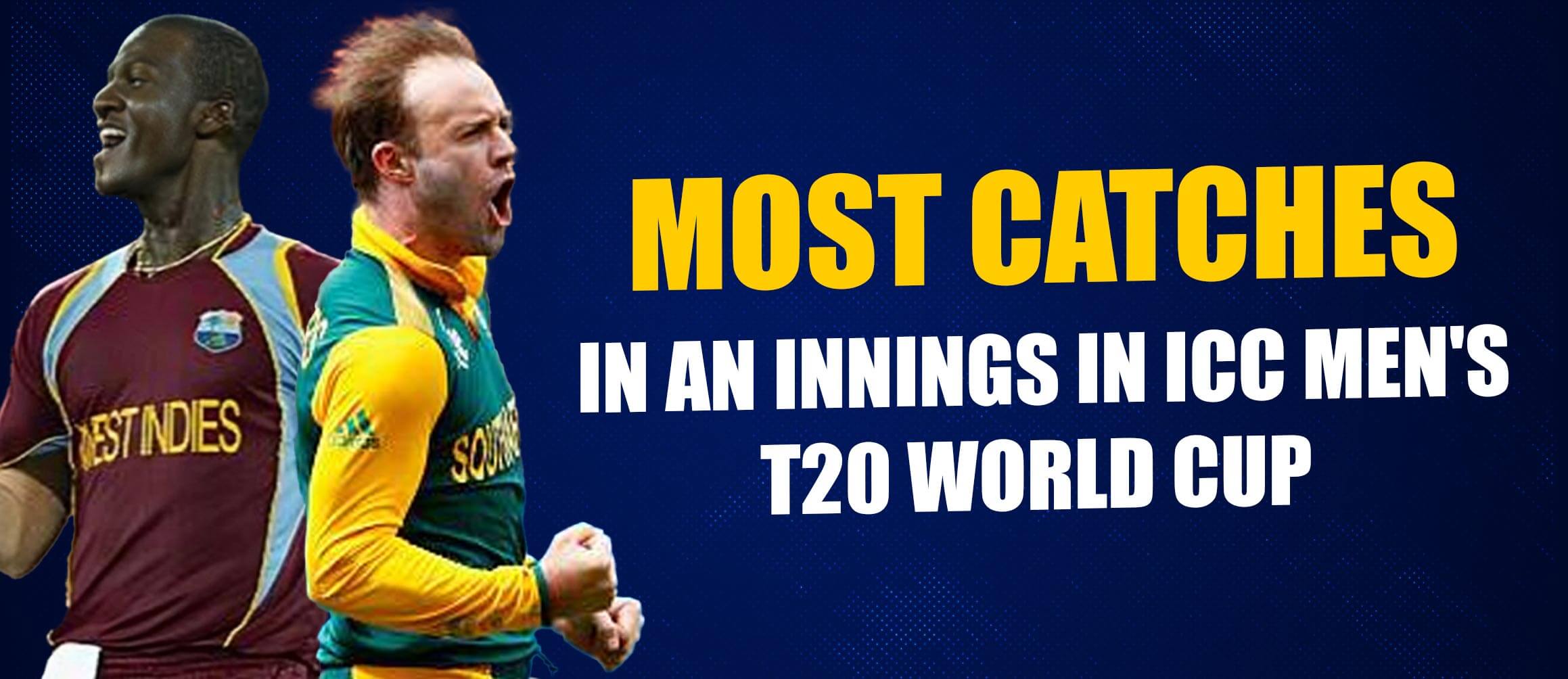
Most Catches in An Innings in ICC Men’s T20 World Cup
• 29 Apr, 24 • by Flash ExchangeThe ICC Men's T20 World Cup is a whirlwind of big hits, lightning-fast bowling, and heart-stopping moments. But sometimes, the most spectacular plays happen away from the batsman or bowler – in the field! Here, we celebrate the players with the most catches snagged in a single innings throughout T20 World Cup history.
-

IPL 2025: Zaheer Khan Joins Lucknow Super Giants as Mentor
• 29 Aug, 24 • by Flash ExchangeIn a significant move ahead of the IPL 2025, Lucknow Super Giants (LSG) have brought on board former Indian pacer Zaheer Khan as their mentor. This appointment comes as LSG
-

ICC Announces Winners for The Men’s and Women’s Player of The Month for September 2024
• 16 Oct, 24 • by Flash ExchangeThe cricketing world has witnessed some incredible performances in September 2024, and the ICC has recognized the best of the best